Physical Address
304 North Cardinal St.
Dorchester Center, MA 02124
Physical Address
304 North Cardinal St.
Dorchester Center, MA 02124
AI image generators have become essential tools for content creators, designers, marketers, bloggers, and businesses. What once required hours of design work can now often begin with a simple text prompt.
In 2026, the best AI image generators go far beyond basic text-to-image creation. Many can edit existing photos, preserve characters across revisions, render readable text, generate marketing graphics, create photorealistic scenes, and transform reference images into entirely new styles.
Recent improvements have been significant. OpenAI’s current ChatGPT Images experience emphasizes sharper details and more precise editing, while Google’s Nano Banana 2 focuses on high-fidelity generation, fast editing, subject consistency, and instruction following.
But which AI image generator should you actually use?
This guide compares some of the best AI image generators in 2026, what each tool is best at, and how to choose the right one for your creative workflow.
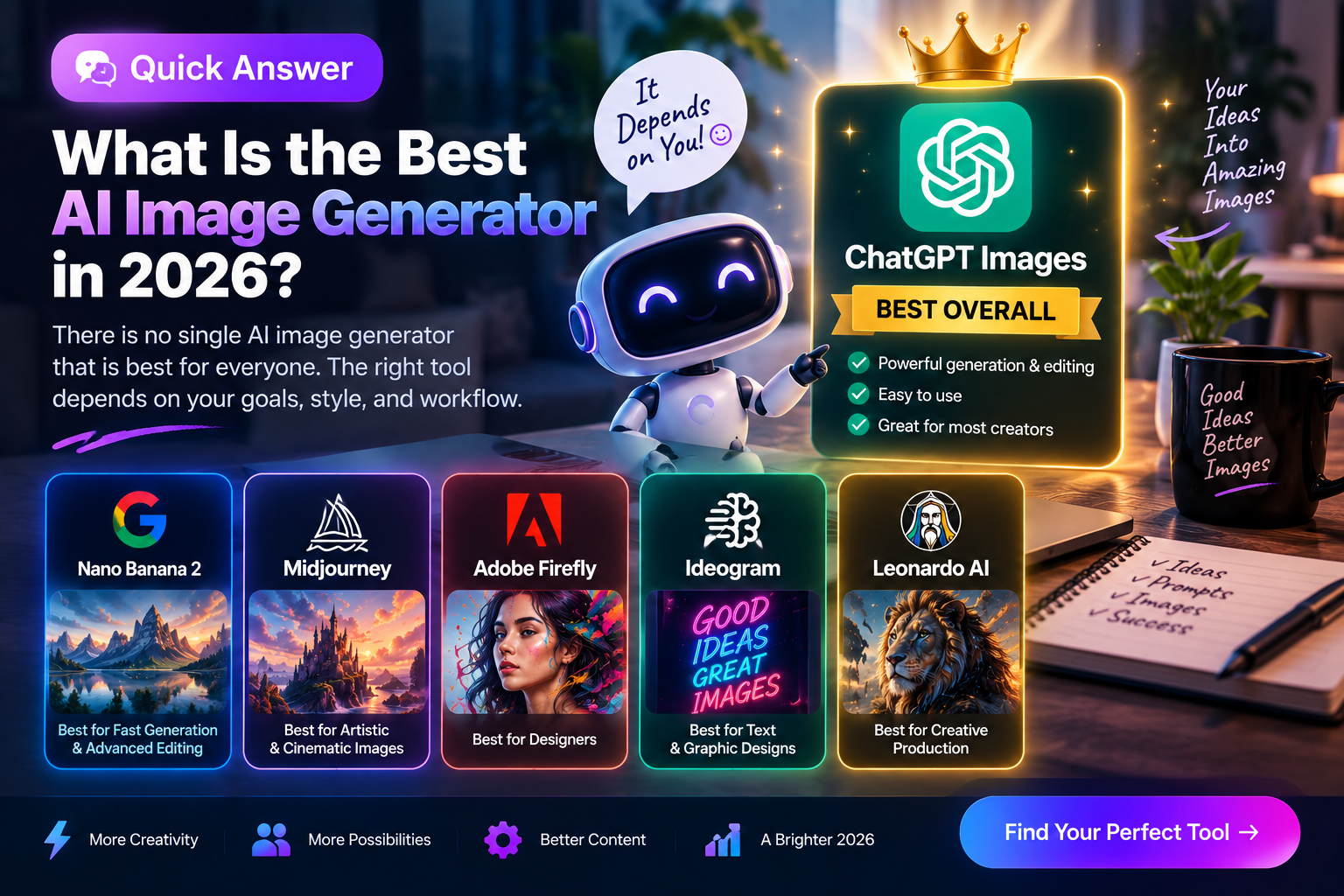
There is no single AI image generator that is best for everyone.
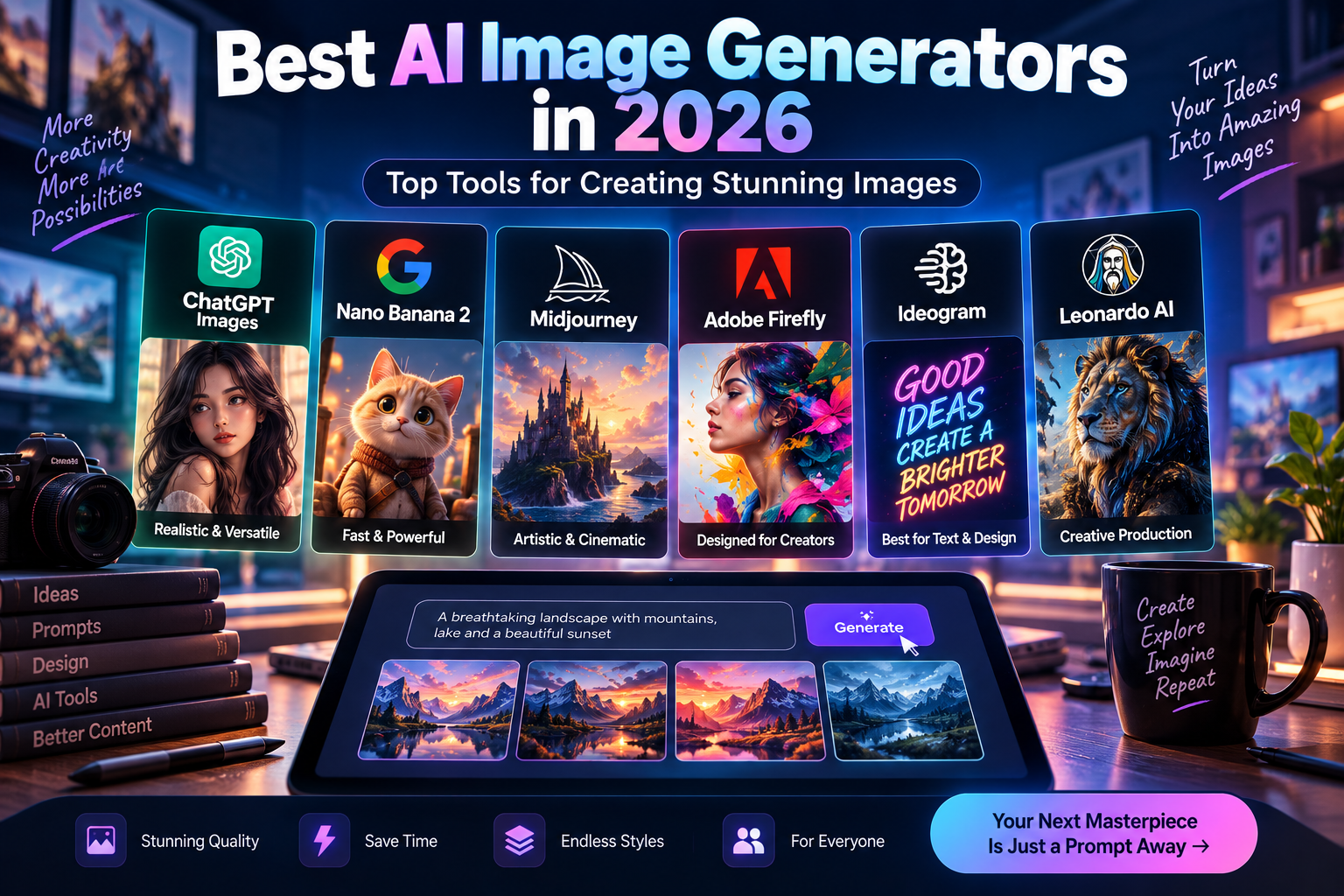
For general-purpose image generation and conversational editing, ChatGPT Images is one of the strongest options. For fast generation, editing, and subject consistency, Google’s Nano Banana 2 is another major option. Other platforms such as Midjourney, Adobe Firefly, Ideogram, and Leonardo AI can be better suited to particular creative workflows.
The best choice ultimately depends on whether you prioritize photorealism, graphic design, image editing, text rendering, character consistency, speed, or creative control.
| AI Image Generator | Best For |
|---|---|
| ChatGPT Images | Best overall for generation and editing |
| Nano Banana 2 | Fast generation and advanced image editing |
| Midjourney | Artistic and cinematic images |
| Adobe Firefly | Designers and Adobe workflows |
| Ideogram | Typography and graphic designs |
| Leonardo AI | Creative assets and production workflows |
Let’s look at each option in more detail.
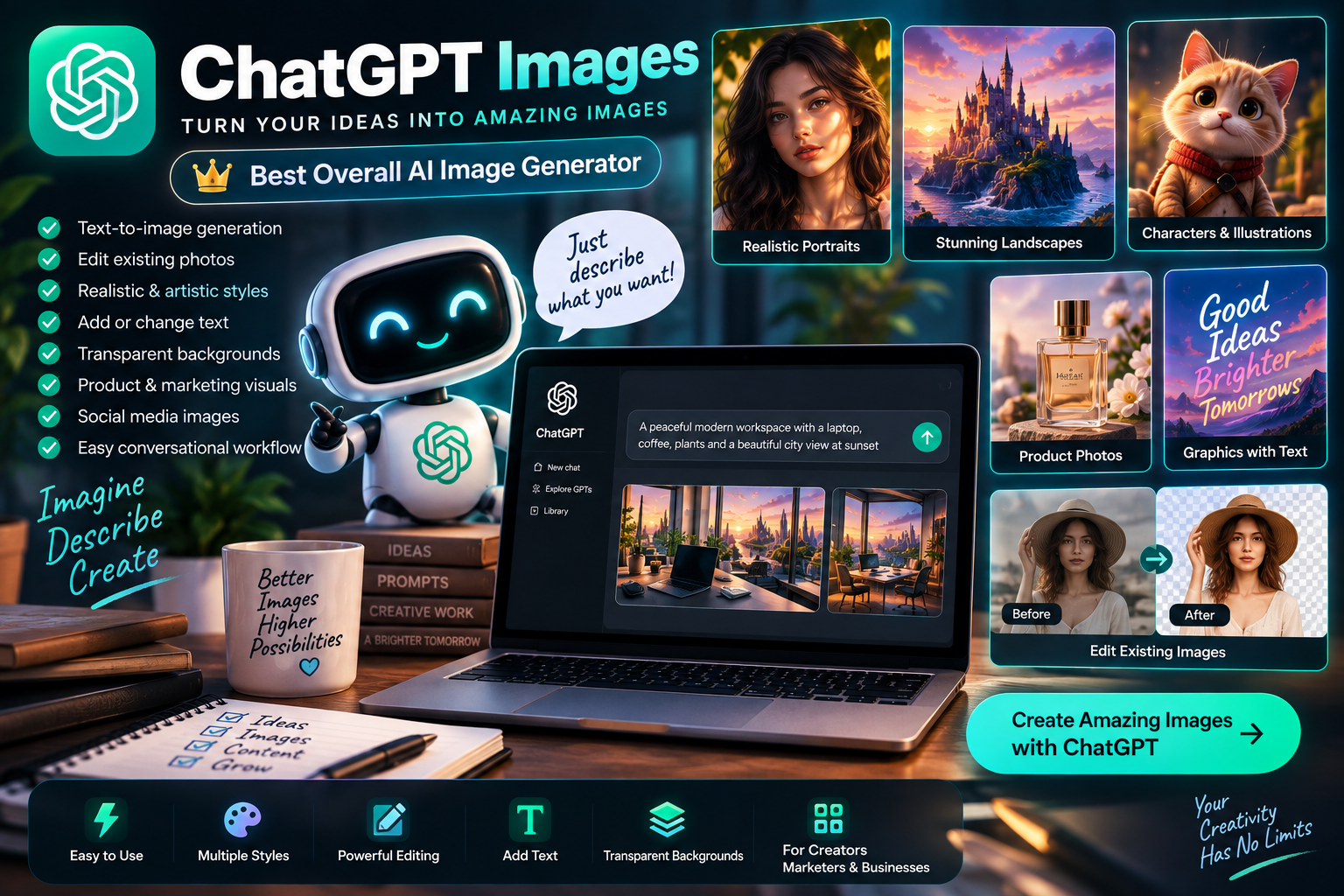
ChatGPT Images is one of the most versatile AI image generators available in 2026 because image creation and editing happen directly through a conversation.
Instead of learning a complicated interface, you can simply describe what you want. You can then continue the conversation to change individual elements, adjust the composition, alter the style, or modify an uploaded image.
The current ChatGPT Images experience supports creating new images as well as editing existing ones. OpenAI says the latest experience provides sharper details, more precise editing, and faster generation. It can also follow instructions involving text and details within images, and users can request transparent backgrounds.
ChatGPT Images is particularly useful for:
One of its strongest advantages is the editing workflow.
You can upload an existing image and explain what should change rather than rebuilding the entire design from scratch. OpenAI also says users can select a specific part of an image when they want an edit applied to a particular area.
ChatGPT Images is particularly suitable for bloggers, marketers, social-media creators, entrepreneurs, designers, and users who want image generation and editing without learning complicated software.
Google’s Nano Banana 2, officially Gemini 3.1 Flash Image, is another major AI image generation model in 2026.
Google introduced Nano Banana 2 in February 2026, combining high-quality image generation with faster editing and iteration. Google highlights capabilities including improved world knowledge, subject consistency, instruction following, and production-ready output.
This makes it particularly interesting when you need to create multiple variations while maintaining important characteristics of the original subject.
Nano Banana 2 offers capabilities such as:
Google has also integrated its image-generation technology deeply into Gemini. In some supported experiences, users can combine Gemini’s image tools with personal context and Google Photos.
Nano Banana 2 is an excellent choice for creators who prioritize speed, image editing, consistency, and integration with Google’s AI ecosystem.
Midjourney remains one of the most recognizable names in AI-generated artwork.
It is especially popular among creators who want highly stylized, atmospheric, cinematic, fantasy, editorial, or concept-art imagery.
Rather than focusing exclusively on practical marketing graphics, Midjourney has built a strong reputation around visual aesthetics.
This makes it especially appealing for concept artists, designers, social-media creators, storytellers, and users looking for visually striking results.
Midjourney is particularly useful for:
If visual style is your highest priority, Midjourney deserves a place on your shortlist.
Adobe Firefly is particularly attractive to professional creators already working within Adobe’s creative ecosystem.
Instead of treating generative AI as an isolated tool, Adobe integrates generative features into creative workflows used for photography, graphic design, advertising, and content production.
That makes Firefly particularly relevant to designers who want AI assistance while continuing to work with familiar Adobe products.
Adobe Firefly is worth considering for:
For users already spending significant time inside Adobe applications, integration can be more important than simply choosing the AI model that produces the prettiest standalone image.
Creating readable text inside generated images has historically been one of the biggest challenges for AI image generators.
Ideogram became particularly well known for tackling this problem.
That makes it useful when the text itself is an important part of the final design rather than something that will be added later in another application.
Ideogram can be particularly useful for:
For creators who frequently need words incorporated directly into visual designs, Ideogram is worth testing alongside more general-purpose AI image generators.
Leonardo AI is another platform built around AI-powered visual creation.
It is particularly relevant to creators who need more than occasional image generation and want a broader creative production environment.
Its use cases span digital art, marketing assets, character concepts, game-related artwork, product concepts, and other creative visuals.
Leonardo AI can work well for:
Two of the most interesting choices in 2026 are ChatGPT Images and Google’s Nano Banana family.
Both can generate and edit images, but their surrounding ecosystems are different.
ChatGPT’s biggest advantage is its conversational workflow. You can generate an image, discuss what needs changing, upload references, and continue refining the result within the same conversation.
Google, meanwhile, emphasizes Nano Banana 2’s speed, high fidelity, subject consistency, world knowledge, and advanced editing.
For many users, the better choice will depend less on a single benchmark and more on which workflow feels easier for the type of images they repeatedly create.
Before choosing an AI image generator, consider what you actually plan to create.
If you mainly need general image creation and editing, ChatGPT Images is a strong place to start.
If you want fast generation, reference-based editing, and subject consistency, Nano Banana 2 is worth considering.
For artistic and cinematic visuals, Midjourney may be more suitable.
Designers already working with Adobe should consider Adobe Firefly, while creators who regularly need text-heavy graphics may prefer Ideogram.
The important point is that the “best” AI image generator depends on your workflow rather than the name of the model alone.
Modern AI image generators can now support a surprisingly broad range of creative projects.
Creators use them for blog featured images, YouTube thumbnails, social-media posts, advertisements, product concepts, characters, illustrations, website graphics, posters, fashion concepts, story scenes, backgrounds, and marketing campaigns.
The ability to edit existing images is becoming equally important.
Instead of generating everything from scratch, you can increasingly start with an existing visual and ask AI to change clothing, backgrounds, lighting, composition, text, objects, or style.
This shift from simple generation toward generation + editing is one of the most important developments in AI image tools.
Many AI image platforms offer some form of free access, limited generation, credits, or access through a broader subscription, but these policies change frequently.
For example, OpenAI currently states that ChatGPT Images is available across ChatGPT tiers, although some advanced image functionality varies by plan.
Google has also made some Gemini image-generation capabilities available free to eligible users, while other features can depend on region and subscription level.
Always check the current pricing page before choosing a tool based primarily on price.
There isn’t one universal winner. ChatGPT Images is a strong general-purpose choice for image creation and editing, while Nano Banana 2, Midjourney, Adobe Firefly, Ideogram, and Leonardo AI each have strengths for different creative workflows.
ChatGPT Images is one of the easiest options for beginners because users can describe what they want conversationally and continue requesting edits without learning a complicated professional interface.
Several leading tools can produce photorealistic results. The final quality depends heavily on the prompt, reference images, model, and type of scene being generated.
ChatGPT Images and Google’s Nano Banana models are particularly notable for combining image generation with natural-language editing. Both support workflows where existing images can be modified rather than recreated entirely.
Ideogram is particularly associated with text-focused image generation, while current ChatGPT Images and Google’s Nano Banana models also emphasize improved text rendering. OpenAI specifically highlights stronger dense-text rendering in its image-generation improvements, while Google says Nano Banana 2 can add text in multiple languages.
Yes. Modern AI image tools increasingly support both creation and editing. ChatGPT Images, for example, lets users upload an existing image and describe the changes they want.
AI-generated visuals can be useful for featured images, illustrations, explainers, and supporting graphics. However, commercial-use terms vary between services, so publishers should review the current licensing and usage terms of the specific platform they use.
The best AI image generators in 2026 are no longer simply tools that turn a sentence into a picture.
They are becoming complete creative environments capable of generating, editing, transforming, and refining visual content.
ChatGPT Images is one of the strongest all-around choices for conversational creation and editing. Nano Banana 2 stands out for speed, high-fidelity generation, editing, and consistency. Midjourney remains compelling for artistic imagery, while Adobe Firefly, Ideogram, and Leonardo AI serve different professional and creative needs.
The best approach is to choose the tool that matches what you actually create—and, when possible, test more than one with the same prompt before committing to a workflow.